

 +91-9696969696

The Economic Times
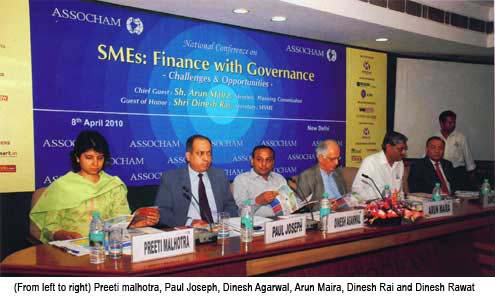
The Balance Sheet is the life blood of enterprise. It must be kept in good health as only the balance sheet attracts the oxygen needed to survice and grow. This is the explanation given by Dinesh Agarwal, Founder and CEO, IndiaMART.com, the successful Indian B2B portal.
He was ‘x-raying’ the MSME sector’s impediments to growth and the measures required to remove the funding road blocks at the ASSOCHAM Seminar on ‘SMEs-Finance with Governance in Delhi recently. SME WORLD was the magazine partner at the event.
“Micro, small and medium enterprises, especially the micro and the small do not worry about their balance sheets ‘which are often guided by their profit and loss accounts. Balance sheet should never be treated casually. In the mad rush to upward their tax saving graph they neglect to symbolize their rate of growth in their balance sheet which is the primary need to raise funds from all sources – banks, private equity, venture capitalists or anywhere.”
Agarwal expressed his concern about this serious issue of the blatant neglect of their balance sheets by the SMEs. He said, “most of the micro enterprises are hurting their balance sheet. Almost all their efforts are targeted to save the taxes or get subsidies or any other promotional assistance from the government.”
Agarwal observed ‘the government must simplify the tax structure’. He said the enterprises often feared to show their growth in their balance sheets and in the process they become keen to remain in the 10% and 20% tax brackets. “Rather than focusing on tax slabs, there must be gradual shift in the tax limits,” he said.
Sharing his experience of dealing with thousands of SMEs everyday, he said “our interaction with enterprises has revealed that there are essentially two kinds of enterprises. One is those who are growing regularly and the other who are waiting for the government’s initiatives to excel.”
Raising the issue of complexity of the government schemes, he urged the government to have fewer schemes rather than a whole gamut of them which eventually die down on their own. “There is a need to simplify the procedures to take benefits of different schemes. Multiple mechanisms to avail the benefits of the schemes and assistance being rendered by the government are cumbersome and discourage the entrepreneur. The schemes should have an elaborate canvas with tangible framework to attract maximum number of the targeted segment.”
Agarwal pointed out that most of the schemes create unnecessary confusion and remain on papers because either they are not publicized or they are too complicated.